

A large warehouse industrial door is a heavy-duty access solution designed for modern logistics centers, distribution hubs, and large-scale storage facilities. As warehouses continue to expand in size and automation level, the demand for durable, fast-operating, and energy-efficient door systems has significantly increased.
Large warehouse industrial doors are engineered to handle oversized openings, frequent operation cycles, and demanding environmental conditions while maintaining security, thermal stability, and smooth traffic flow. These systems play a critical role in improving logistics efficiency, reducing energy loss, and ensuring safe and reliable access for forklifts, trucks, and personnel.
Whether used in cold chain logistics, e-commerce distribution centers, manufacturing storage areas, or industrial parks, large warehouse industrial doors are an essential component of modern industrial infrastructure.
Large warehouse industrial doors are specifically designed for wide and tall openings, typically used in industrial warehouses and logistics buildings.
Key structural advantages include:
Reinforced steel or aluminum alloy frames
High-strength lifting systems
Wind-resistant door panels
Stable guide rail systems
Modular structure for large spans
These features ensure safe and stable operation even in extremely large door openings.
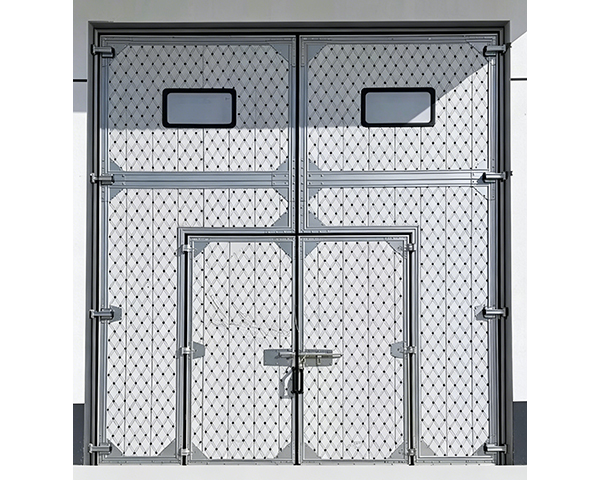
Warehouses require doors that can withstand continuous operation and mechanical stress. Large warehouse industrial doors are built with industrial-grade materials such as:
Galvanized steel sheets
Reinforced sandwich panels
Heavy-duty PVC curtains (optional type)
Anti-corrosion coatings
This ensures long service life even in high-frequency logistics environments.
Efficient logistics depends on fast access. These industrial doors support:
Rapid opening and closing cycles
Smooth lifting and sliding systems
Intelligent motor control
Automatic sensor activation
Typical opening speed ranges from 0.5 to 1.5 m/s depending on configuration.
Large warehouse doors are equipped with advanced sealing systems that reduce:
Air leakage
Dust infiltration
Heat loss
Moisture penetration
Insulated models significantly improve energy efficiency in temperature-controlled warehouses.
Modern warehouse doors integrate intelligent automation technologies:
Radar motion sensors
RFID access control
Remote control operation
PLC intelligent controller
Warehouse management system integration
This improves automation and operational efficiency in logistics centers.
Safety is a key requirement in warehouse environments with frequent forklift movement.
Safety systems include:
Infrared photoelectric sensors
Anti-collision protection
Emergency stop system
Safety bottom edge
Manual override function
Specifications can be customized according to project requirements.
| Parameter | Specification |
|---|---|
| Product Type | Large Warehouse Industrial Door |
| Door Structure | Sliding / Sectional / Rolling / Lift-up |
| Maximum Width | Up to 20–30 m |
| Maximum Height | Up to 15–20 m |
| Material | Galvanized Steel / Aluminum Alloy / PVC |
| Panel Thickness | 40–100 mm |
| Opening Speed | 0.5–1.5 m/s |
| Wind Resistance | Class 8–12 |
| Insulation Type | Polyurethane Foam (optional) |
| Power Supply | 220V / 380V |
| Control System | PLC Intelligent Control |
| Motor Type | Industrial Servo Motor |
| Operation Cycles | 1,000,000+ cycles |
| Protection Level | IP54–IP65 |
| Operating Temperature | -40°C to +70°C |
The door panels are designed for large-scale openings and continuous operation.
Features:
High structural strength
Impact resistance
Weather protection
Optional insulation layer
The steel frame ensures structural stability for oversized installations, preventing deformation under wind pressure or heavy usage.
High-torque motors ensure stable lifting and movement even for extremely large doors.
Benefits:
Strong power output
Smooth acceleration
Low noise operation
Long service life
The control system manages:
Door opening and closing
Safety monitoring
Sensor integration
Fault detection
Remote operation
Warehouse safety systems include multi-layer protection for personnel and equipment.
Large warehouse industrial doors are widely used in distribution hubs and logistics parks.
Applications:
Loading and unloading docks
Truck entry points
Sorting centers
Cross-docking facilities
They help maintain fast cargo flow and operational efficiency.
High-volume e-commerce warehouses require rapid door operation for continuous shipping and receiving processes.
Benefits:
Faster parcel handling
Reduced waiting time
Improved workflow efficiency
Factories use large industrial doors to connect production lines and storage zones.
Functions:
Material transfer
Equipment access
Semi-finished product storage
Insulated large warehouse doors help maintain low-temperature environments.
Applications:
Refrigerated logistics
Frozen food storage
Pharmaceutical cold chain
Large facilities require durable access solutions for trucks, machinery, and transport vehicles.
Large-span doors are used in hangars, maintenance workshops, and heavy equipment storage buildings.

Fast opening systems reduce vehicle waiting time and improve warehouse throughput.
Insulated structures help reduce HVAC energy consumption in large buildings.
Strong steel structures and access control systems improve facility security.
Suitable for both indoor and outdoor industrial environments.
Designed for millions of operating cycles with minimal maintenance.
Proper installation is critical for large-scale industrial doors.
Confirm structural load capacity
Verify opening dimensions
Ensure electrical supply readiness
Check installation clearance
Install main support structure
Assemble guide rails
Mount door panels or curtain system
Install motor and drive system
Connect control cabinet
Install safety sensors
Test full operation
Check smooth movement
Verify sensor response
Test emergency stop
Confirm sealing performance
Ensure area is clear
Activate control system
Door opens automatically
Complete operation cycle safely
Sensors detect vehicles or personnel and trigger automatic opening.
Do not stand under moving door
Keep sensor area clean
Avoid obstruction during operation
Report abnormal noise or movement
In case of power failure:
Use manual release system
Operate door manually if required
Restore automatic mode after power recovery
Check door movement
Inspect sensors
Ensure no obstructions
Observe unusual sounds
Inspect motor system
Check bolts and fasteners
Clean guide rails
Test safety devices
Electrical system inspection
Structural integrity check
Full safety system testing
Component replacement if needed
It is a heavy-duty industrial door designed for oversized warehouse openings, supporting high-frequency logistics operations.
Doors can be customized up to 20–30 meters wide and 15–20 meters high depending on project requirements.
Yes, insulated sandwich panel designs are available for temperature-controlled warehouses.
Yes, it is designed for over 1,000,000 operating cycles in high-traffic environments.
Yes, insulated models are widely used in cold chain logistics and freezer warehouses.
Standard systems include sensors, safety edges, emergency stop, and obstacle detection.
Yes, it supports RFID, radar, PLC control, and warehouse management system integration.
Large warehouse industrial doors are essential infrastructure for modern logistics and industrial operations. Their oversized structural design, high-speed performance, strong durability, and intelligent control systems make them ideal for warehouses, distribution centers, manufacturing facilities, and cold chain logistics environments.
By improving efficiency, reducing energy consumption, and enhancing safety, large warehouse industrial doors deliver long-term operational value for high-performance industrial facilities.
A large warehouse industrial door is a heavy-duty access system designed for wide-span openings in warehouses, logistics hubs, distribution centers, manufacturing plants, and industrial storage facilities. These doors are engineered to handle high-frequency operation, large vehicle traffic, environmental exposure, and strict energy efficiency requirements.
In modern supply chain systems, warehouse efficiency depends heavily on how quickly goods can move in and out of buildings. A large warehouse industrial door plays a critical role in reducing loading time, improving traffic flow, maintaining indoor climate control, and ensuring security.
As global logistics, e-commerce fulfillment, and automated warehousing continue to expand, the demand for high-performance large industrial door systems continues to grow rapidly.
This guide provides a detailed overview of design structures, materials, operational systems, performance standards, benefits, applications, and technical specifications of large warehouse industrial doors.
What Is a Large Warehouse Industrial Door?
A large warehouse industrial door is an oversized industrial entrance system designed for:
Wide vehicle access
Forklift traffic
Truck loading docks
Industrial logistics operations
High-cycle opening and closing
These doors are typically installed in openings ranging from medium-large to extremely large spans, often exceeding standard commercial door dimensions.
They are engineered for:
Strength
Durability
Fast operation
Thermal insulation
Security
Automation compatibility
Why Large Warehouse Industrial Doors Are Essential
Modern warehouse operations depend on speed and efficiency. Any delay in door operation can result in:
Reduced logistics throughput
Increased energy loss
Traffic congestion
Higher labor costs
A large warehouse industrial door helps solve these challenges by providing:
Efficient movement of:
Trucks
Forklifts
Pallet systems
Automated guided vehicles (AGVs)
Warehouses often require protection from:
Dust
Rain
Wind
Temperature fluctuations
Large openings can cause significant HVAC losses. Industrial doors reduce:
Heating loss
Cooling loss
Air leakage
They help protect:
Stored goods
Equipment
High-value inventory

Sectional doors are widely used for warehouses due to their insulation and space-saving design.
Multiple horizontal insulated panels
Vertical lift system
Ceiling track guidance
Excellent thermal insulation
Strong sealing performance
Smooth operation
High durability
Logistics centers
Distribution warehouses
Cold storage warehouses
Rolling steel doors are ideal for heavy-duty industrial environments.
Interlocking steel slats
Vertical rolling system
Compact structure
High security
Strong wind resistance
Cost-effective maintenance
Designed for high-frequency logistics operations.
Rapid opening and closing
Automatic sensors
High-cycle motor systems
Improved logistics efficiency
Reduced energy loss
Better traffic flow
Sliding doors are used for extremely wide openings.
Horizontal movement
Heavy structural frames
Reinforced guide rails
Aircraft hangars
Heavy manufacturing plants
Large storage facilities
Folding doors are used when maximum opening width is required.
Wide clear opening
Strong wind resistance
Flexible design
Key Components of Large Warehouse Industrial Doors
Door panels form the main barrier system.
| Material | Function |
|---|---|
| Galvanized Steel | Structural strength |
| Aluminum Alloy | Lightweight performance |
| Insulated Steel Panels | Energy efficiency |
| Composite Panels | Thermal + acoustic control |
Supports the entire door structure.
Reinforced steel construction
Corrosion-resistant coating
Load-bearing design
Ensures smooth operation.
| Drive Type | Application |
|---|---|
| Chain Drive | Medium-large doors |
| Gear Motor Drive | Heavy-duty systems |
| Direct Drive | High-speed warehouse doors |
Guide rails ensure stability during movement.
Materials:
Galvanized steel
Stainless steel
Heavy-duty aluminum alloy
Modern warehouse doors rely on automation.
Functions include:
Automatic opening
Motion detection
Remote control
System diagnostics

Safety is critical in warehouse environments.
Photoelectric sensors
Safety edges
Emergency stop systems
Anti-collision detection
Technical Specifications of Large Warehouse Industrial Doors
| Parameter | Typical Range |
|---|---|
| Door Width | 3m – 30m |
| Door Height | 3m – 12m |
| Panel Thickness | 40mm – 120mm |
| Steel Thickness | 0.5mm – 2.5mm |
| Opening Speed | 0.2 – 2.5 m/s |
| Wind Resistance | Class 5 – Class 12 |
| Operating Cycles | 100,000 – 1,000,000+ |
| Motor Power | 1.1 – 7.5 kW |
| Operating Temperature | -40°C to +70°C |
| Protection Level | IP54 – IP65 |
Materials Used in Large Warehouse Industrial Doors
Widely used for durability and strength.
High structural integrity
Corrosion resistance
Long service life
Used in harsh environments.
Rust resistance
Hygienic surface
Chemical resistance
Used for lightweight large doors.
Easy operation
Corrosion resistance
Modern appearance
Used in temperature-controlled warehouses.
Thermal Insulation Performance
Large warehouse industrial doors often require insulation for energy efficiency.
| Property | Value |
|---|---|
| Density | 40–50 kg/m³ |
| Thermal Conductivity | 0.022–0.028 W/m·K |
| Performance | Excellent |
| Property | Value |
|---|---|
| Fire Resistance | High |
| Sound Absorption | High |
| Thermal Performance | Good |
Applications of Large Warehouse Industrial Doors
Used in distribution centers handling high daily traffic.
Benefits:
Fast loading/unloading
Efficient logistics flow
Require rapid door operation for continuous shipments.
Require insulated doors for temperature control.
Used to separate production zones.
Used for large equipment and material storage.
Support vehicle and parts movement.
Advantages of Large Warehouse Industrial Doors
Fast access improves workflow speed.
Reduces HVAC energy consumption.
Protects warehouse assets.
Supports oversized vehicles and equipment.
Designed for high-cycle use.
Compatible with smart warehouse systems.
Wind Resistance Performance
Large warehouse doors must withstand strong external forces.
| Class | Application |
|---|---|
| Class 5 | Standard warehouses |
| Class 8 | Industrial zones |
| Class 10 | Coastal areas |
| Class 12 | Extreme wind regions |
Automation Features
Detect incoming vehicles.
Enhances security and automation.
Allow centralized operation.
Connects with:
Warehouse Management Systems (WMS)
Logistics tracking systems
Automated conveyor systems
Safety Features
Prevent accidents during operation.
Instant shutdown capability.
Allows manual control during emergencies.
Protect personnel in entry zones.
Energy Efficiency Benefits
Large warehouse industrial doors significantly reduce energy consumption.
Lower heating costs
Reduced cooling expenses
Improved HVAC efficiency
Reduced carbon footprint
Maintenance Requirements
Door movement
Sensor response
Track condition
Lubrication
Motor inspection
Fastener checks
Structural evaluation
Electrical system testing
Safety system calibration
Common Problems and Solutions
| Problem | Cause | Solution |
|---|---|---|
| Door Stuck | Motor failure | Inspect drive system |
| Slow Operation | Wear or friction | Lubricate components |
| Noise | Misalignment | Adjust rails |
| Air Leakage | Seal damage | Replace seals |
| Sensor Failure | Dust or wiring issue | Clean or repair |
Selection Guide for Large Warehouse Industrial Doors
Determine:
Width
Height
Clearance needs
High traffic requires:
High-cycle motors
Durable components
Consider:
Temperature
Wind load
Humidity
Important for cold storage and energy-saving warehouses.
Evaluate integration with:
Smart warehouse systems
Logistics automation
Security systems
Industry Trends
Integration with AI and IoT systems.
Focus on reducing operational energy consumption.
Faster opening systems for logistics efficiency.
Use of recyclable and eco-friendly materials.
AI-based monitoring reduces downtime.
Future Development of Large Warehouse Industrial Doors
Future innovations include:
Fully automated logistics integration
AI-controlled opening systems
Ultra-lightweight composite materials
Advanced insulation technologies
Self-diagnostic safety systems
Frequently Asked Questions
It is used for large industrial openings in warehouses, logistics centers, and manufacturing facilities to enable efficient movement of goods and vehicles.
Sizes vary, but typically range from 3 meters to 30 meters wide depending on facility requirements.
Yes, many models use polyurethane or rock wool cores for thermal insulation.
Yes, they can integrate with sensors, RFID systems, and warehouse automation platforms.
With proper maintenance, lifespan can reach 10–25 years depending on usage intensity.
A large warehouse industrial door is a critical infrastructure component in modern logistics, manufacturing, and storage facilities. It provides fast access, strong security, energy efficiency, and reliable performance in high-demand environments.
As warehouses continue to evolve toward automation and smart logistics systems, large industrial doors will play an even more important role in improving efficiency, reducing operational costs, and supporting sustainable industrial development.
Shenyang Manlong Metal Ürünleri Co, Ltd


Telif Hakkı © 2026 Shenyang Manlong Metal Products Co., Ltd. Tüm hakları saklıdır. Uygulamalar
Bu web sitesi, web sitemizde en iyi deneyimi yaşamanızı sağlamak için çerezleri kullanır.

 English
 Español
 Portugues
 Pусский
 Français
 Deutsch
 العربية
 ไทย
ไทย Tiếng Việt



 Telefon