

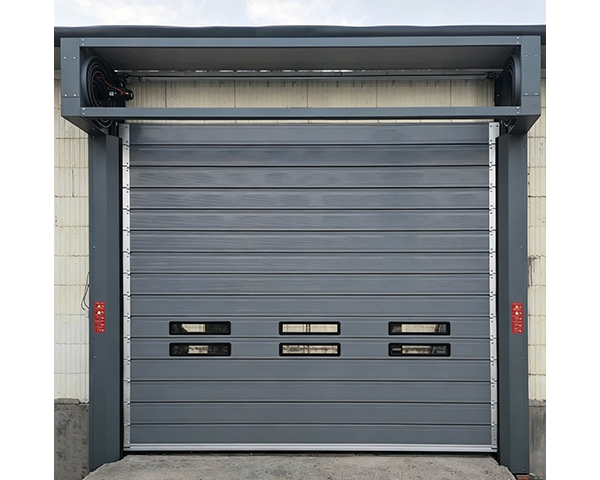
Aluminum industrial doors have become a preferred solution in modern architecture because they combine strength, durability, visual appeal, and design flexibility. In commercial buildings, industrial facilities, logistics centers, warehouses, factories, and large public spaces, the demand for door systems has shifted toward materials that can support high performance while also meeting contemporary architectural standards. Aluminum industrial doors fit this requirement well, offering a balance between structural reliability and modern aesthetics.
As architecture continues to move toward cleaner lines, larger openings, energy efficiency, and long-term sustainability, aluminum industrial doors play an increasingly important role. They are widely used in projects where frequent operation, weather resistance, low maintenance, and customizable appearance are important. Compared with many traditional door materials, aluminum provides a strong yet lightweight framework that supports functional performance without adding unnecessary bulk.
This article provides a detailed, SEO-friendly overview of aluminum industrial door advantages in modern architecture. It covers definitions, core benefits, technical specifications, application areas, performance features, and a practical comparison table. The goal is to offer original, industry-focused content that can be inserted directly into a blog post, category page, or industry landing page.
An aluminum industrial door is a heavy-duty door system constructed primarily from aluminum components and designed for industrial or commercial environments. These doors are engineered to handle frequent opening and closing cycles, harsh weather conditions, security requirements, and large openings commonly found in warehouses, factories, distribution centers, loading bays, logistics hubs, and modern commercial buildings.
Unlike standard residential doors, aluminum industrial doors are built for performance under demanding conditions. They may be configured as sectional doors, sliding doors, rolling doors, overhead doors, fold-up doors, or large glazed entrance systems depending on the project’s architectural and operational needs. Aluminum is often selected because it is corrosion-resistant, lightweight, structurally stable, and visually compatible with modern architectural design.
In modern architecture, aluminum industrial doors are not only functional barriers. They are also part of the building’s visual identity, energy strategy, and operational workflow. Many projects require doors that can integrate with curtain wall systems, insulated façades, automation controls, access systems, and safety equipment. Aluminum offers the flexibility needed to meet these multi-purpose demands.
Modern architecture values materials that are efficient, adaptable, durable, and visually refined. Aluminum meets these expectations in many ways. It is strong relative to its weight, naturally resistant to rust, and easy to fabricate into precise profiles. These characteristics make aluminum highly suitable for large-scale doors that need to perform reliably in both industrial and commercial environments.
Architects and developers also favor aluminum because it supports clean geometric lines, large transparent surfaces, and customized finishes. This is especially important in contemporary buildings where doors are expected to contribute to the overall architectural language rather than appear purely utilitarian. Aluminum industrial doors can be powder coated, anodized, or paired with glass panels to achieve a wide range of aesthetic outcomes.
Another reason aluminum is widely used is its compatibility with energy-conscious building design. When combined with thermal breaks, insulated panels, and high-performance sealing systems, aluminum industrial doors can help reduce heat loss, improve indoor comfort, and support building efficiency goals. This makes them useful in projects that prioritize sustainable construction and long-term operational savings.
One of the main advantages of aluminum industrial doors is the combination of light weight and structural strength. Aluminum is significantly lighter than many other metals, which reduces the load on hinges, tracks, frames, and automation systems. At the same time, properly engineered aluminum profiles can withstand substantial operational stress and environmental exposure.
This balance is especially valuable in modern architecture, where large openings are common. A lighter door system is easier to operate, easier to automate, and less likely to put excessive strain on supporting hardware. For buildings that require frequent door cycles, this can contribute to smoother performance and longer service life.
Aluminum naturally forms an oxide layer that protects it from corrosion. This makes aluminum industrial doors highly suitable for environments with moisture, humidity, coastal air, or fluctuating temperatures. In industrial and architectural settings where metal components may be exposed to rain, condensation, or cleaning chemicals, corrosion resistance is a major benefit.
This property reduces the need for frequent repainting or rust treatment, helping maintain both appearance and functionality over time. For modern buildings, especially those with premium exterior finishes, corrosion resistance helps preserve the visual quality of the façade and entrance system.
Aluminum industrial doors are widely used in modern architecture because they support sleek, minimal, and contemporary designs. Their profiles can be slim yet strong, allowing for large glazed sections, crisp edges, and visually balanced proportions. This makes them ideal for architecture that values openness, transparency, and visual simplicity.
Aluminum can be finished in many ways, including matte, gloss, textured, metallic, and custom color coatings. This flexibility allows designers to align door systems with brand identity, façade concepts, or interior design themes. Whether the project calls for a clean industrial look or a more refined architectural statement, aluminum offers a highly adaptable visual solution.
Industrial door systems must endure heavy use, repeated cycles, impacts, and environmental stress. Aluminum industrial doors are known for their durability when properly engineered and installed. They maintain stable performance over time and are less likely to warp, crack, or deteriorate in the way some other materials may under harsh conditions.
Long service life is important not only for operational continuity but also for lifecycle cost management. Buildings that choose durable aluminum door systems can often reduce replacement frequency, minimize downtime, and improve return on investment. This makes aluminum a practical choice for long-term architectural planning.
Modern buildings increasingly favor materials that do not require intensive upkeep. Aluminum industrial doors typically need only basic cleaning and periodic inspection to remain in good condition. They do not require regular anti-rust treatment, and many surface finishes are designed to retain appearance with minimal maintenance.
For facilities with high traffic or multiple access points, low maintenance is a major operational advantage. It helps reduce labor costs, limits interruptions, and makes it easier to preserve the appearance and function of the building entrance over time. This is particularly valuable in logistics centers, manufacturing facilities, and commercial complexes where efficiency matters.
Modern architecture often uses wide door openings for vehicle access, material handling, and large-span interior-exterior transitions. Aluminum industrial doors are well suited to these conditions because the material supports large-format construction without excessive weight. This allows designers to create functional openings while maintaining structural integrity and ease of operation.
Large openings are common in warehouses, hangars, service areas, loading docks, exhibition halls, and public buildings. Aluminum makes it possible to design door systems that are both practical and visually integrated into the overall architecture.
Energy efficiency is a central concern in modern architecture. Aluminum industrial doors can be designed with thermal breaks, insulated panels, weather seals, and advanced glazing systems to improve thermal performance. These features help reduce unwanted heat transfer, support indoor climate control, and lower energy consumption.
In climate-controlled facilities, better insulation can make a meaningful difference in operating costs. It also contributes to occupant comfort and can help buildings meet energy-related performance goals. When compared with uninsulated metal doors, modern insulated aluminum door systems offer much better thermal functionality.
As buildings become smarter and more automated, door systems must integrate with sensors, access control, remote operation, and safety devices. Aluminum industrial doors are highly compatible with automation technologies because their lightweight design and stable structure support efficient motorization and control systems.
This compatibility is important for modern logistics, manufacturing, and commercial buildings that require controlled access, traffic management, or hands-free operation. Aluminum doors can be connected to building management systems, motion sensors, emergency release functions, and security protocols to improve overall functionality.
Depending on the design, aluminum industrial doors can be configured to support enhanced safety and security needs. While fire rating depends on the complete door assembly and applicable standards, aluminum systems can be engineered with fire-resistant components, reinforced frames, locking systems, and access control features.
Security is another important factor in industrial architecture. Aluminum industrial doors can be fitted with robust locking hardware, impact-resistant panels, and reinforced profiles to support protection against unauthorized entry or accidental damage. This makes them suitable for facilities that prioritize secure access management.
Aluminum is one of the most recyclable building materials available. It can be recycled repeatedly without losing its core properties, making it a strong choice for sustainable construction. In modern architecture, material selection often includes environmental considerations, and aluminum performs well in lifecycle assessments due to its recyclability and long-term usability.
Choosing aluminum industrial doors can contribute to responsible resource management and support green building objectives. For projects that value environmental performance, this material offers an important advantage over less recyclable alternatives.
Aluminum industrial doors are used across a wide range of modern architectural projects. Their adaptability makes them suitable for different building types and operational scenarios. Common applications include:
In each of these environments, aluminum industrial doors provide a combination of reliable operation, architectural compatibility, and long-term value. They can be tailored to different performance demands, from high-cycle industrial use to visually prominent commercial entrances.
| Feature | Aluminum Industrial Doors | Steel Doors | Wood Doors | PVC/Plastic Doors |
|---|---|---|---|---|
| Weight | Lightweight | Heavier | Moderate to heavy | Lightweight |
| Corrosion Resistance | Excellent | Needs protective coating | Prone to moisture damage | Good, but limited structural strength |
| Durability | High | Very high | Moderate | Moderate |
| Maintenance | Low | Medium to high | High | Low to medium |
| Appearance | Modern and versatile | Industrial and strong | Traditional and decorative | Functional but less premium |
| Large Opening Suitability | Excellent | Good but heavier | Limited | Limited |
| Automation Compatibility | Excellent | Good | Moderate | Moderate |
| Recyclability | Very high | High | Variable | Lower |
The specifications of aluminum industrial doors vary depending on project requirements, opening size, insulation needs, and local building codes. The following table provides a general reference for common industry specifications. Actual values may differ based on the door type and design.
| Specification | Common Range / Description |
|---|---|
| Material | Extruded aluminum alloy profiles |
| Door Types | Sectional, sliding, rolling, folding, overhead, glazed entrance |
| Surface Finish | Powder coating, anodizing, custom paint finish |
| Panel Options | Solid aluminum panels, insulated panels, glass inserts, composite infill |
| Insulation | Optional thermal break and foam-insulated core |
| Opening Width | Customizable for small to extra-wide industrial openings |
| Opening Height | Customizable for standard and oversized access points |
| Operation | Manual or motorized |
| Hardware | Tracks, rollers, hinges, locks, guides, seals, automation components |
| Weather Sealing | Brush seals, rubber gaskets, bottom seals, perimeter seals |
| Security Features | Multi-point locks, reinforced frames, access control integration |
| Safety Features | Anti-fall systems, photoelectric sensors, emergency stop, manual release |
| Typical Service Life | Long-term use with proper maintenance and installation |
Modern architecture is often defined by openness, efficiency, simplicity, and integration. Aluminum industrial doors support these principles in several ways. First, their structural properties allow for large spans and clean framing, which help create visually coherent façade systems. Second, they can be finished to match or complement the building envelope, ensuring design continuity.
Third, aluminum doors can be combined with glass to increase transparency and natural light penetration. This is especially useful in commercial and industrial spaces where visibility, daylight, and a sense of openness are important. Finally, these doors can be integrated with automated controls and environmental performance features, allowing the architecture to operate intelligently rather than function as a static shell.
In this way, aluminum industrial doors are more than access solutions. They are part of a building’s performance strategy and visual expression. This is why they are increasingly found in contemporary architectural projects that demand both technical performance and design quality.
When choosing aluminum industrial doors for a modern architectural project, several performance factors should be evaluated. These include structural load capacity, thermal insulation, operating frequency, wind resistance, sealing quality, finish durability, and compatibility with safety systems. The selection process should align with the building’s function and environmental conditions.
For example, a warehouse door may prioritize high-cycle durability and wide opening dimensions, while a commercial entrance may emphasize aesthetics, glazing, and automation. A facility in a humid or coastal environment may require enhanced corrosion protection, while a climate-controlled space may need improved insulation. Aluminum is flexible enough to address these different priorities through proper design and specification.
It is also important to consider installation quality and regular maintenance. Even the best aluminum industrial door will underperform if it is improperly installed or neglected over time. Precise alignment, quality hardware, and periodic inspection all contribute to optimal operation and long service life.
One of the reasons aluminum industrial doors are so popular in modern architecture is their design flexibility. Common finish and design options include:
These design options allow aluminum industrial doors to be used in projects ranging from purely functional industrial sites to visually refined commercial architecture. The result is a door system that can support both operational and aesthetic goals.
Aluminum industrial doors offer a powerful combination of durability, corrosion resistance, lightweight construction, low maintenance, and modern design flexibility. In modern architecture, these benefits are especially important because buildings must perform efficiently while also presenting a contemporary visual identity. Aluminum supports large openings, automation, energy efficiency, sustainability, and architectural integration, making it a versatile material for a wide range of industrial and commercial applications.
From warehouses and factories to showrooms, public buildings, and logistics facilities, aluminum industrial doors help improve access control, operational reliability, and façade performance. Their compatibility with thermal insulation, glazing, and smart building technologies makes them a future-ready solution for projects that value both function and form. For architects, developers, and facility planners, aluminum industrial doors remain one of the most practical and adaptable options available in modern construction.
The following keyword themes are commonly associated with aluminum industrial doors and modern architectural applications. They can help improve topical relevance for search engines when used naturally within page content:
Using these themes throughout a page can help strengthen semantic relevance for topics related to aluminum industrial door advantages in modern architecture.
Aluminum industrial doors are an essential part of modern architecture because they address the needs of performance, durability, appearance, and adaptability. Their lightweight strength, corrosion resistance, low maintenance requirements, energy-saving potential, and compatibility with automation make them a highly effective solution for industrial and commercial buildings.
As architectural design continues to evolve, aluminum industrial doors will remain highly relevant due to their ability to support large openings, integrate with contemporary façades, and meet demanding operational standards. For any project that requires a reliable, modern, and versatile door system, aluminum continues to stand out as one of the strongest material choices in the industry.
Shenyang Manlong Metal Ürünleri Co, Ltd


Telif Hakkı © 2026 Shenyang Manlong Metal Products Co., Ltd. Tüm hakları saklıdır. Uygulamalar
Bu web sitesi, web sitemizde en iyi deneyimi yaşamanızı sağlamak için çerezleri kullanır.

 English
 Español
 Portugues
 Pусский
 Français
 Deutsch
 العربية
 ไทย
ไทย Tiếng Việt



 Telefon
Yorum
(0)